If you asked me two years ago whether a single photo could convincingly speak on camera, I would have said “technically possible, but awkward.” In 2025, that answer has changed completely.
Today’s AI Talking photo tools can animate a still image with facial movement, voice, and emotion that’s good enough for marketing, education, onboarding, and global content distribution. Paired with modern Lip Sync AI, these platforms are quietly reshaping how video gets made — especially for teams that don’t want cameras, actors, or editing timelines.
I spent several weeks testing the most relevant tools in this category. Some were impressive. Others looked good in demos but fell apart in real workflows. What follows is a practical, creator-focused breakdown of the best AI Talking photo and Lip Sync AI tools of 2025, starting with the platform that consistently delivered the strongest results.
Quick Comparison: Top AI Talking Photo & Lip Sync AI Platforms
| Platform | Primary Strength | Photo-to-Video Quality | Lip Sync Accuracy | Best For | Free Option |
| Magic Hour | Realistic talking photos + creator control | Excellent | Excellent | Creators, marketers, startups | Yes |
| D-ID | Corporate avatars | Very good | Good | Training, presentations | Limited |
| HeyGen | Fast social video output | Good | Good | Sales, social teams | Trial |
| Synthesia | Enterprise-scale video | Very good | Good | L&D, internal comms | Demo |
| Rephrase.ai | Branded spokespersons | Decent | Moderate | Ads, campaigns | No |
Why AI Talking Photos Matter Now
An AI Talking photo is more than a novelty. It’s a response to a real constraint: attention is expensive, and video still performs better than text in most channels.
The challenge has always been production. Filming people, retakes, lighting, editing — all of that slows teams down. Lip Sync AI removes much of that friction by letting creators animate a single image with voice and believable mouth movement.
Used well, these tools unlock:
Short-form marketing videos
Course lessons without reshoots
Localized content in multiple languages
Founder-led storytelling without a camera
The difference between a useful tool and a gimmick comes down to realism, speed, and how much control the creator retains. That’s where the following tools separate themselves.
1. Magic Hour — Best AI Talking Photo and Lip Sync AI Tool Overall
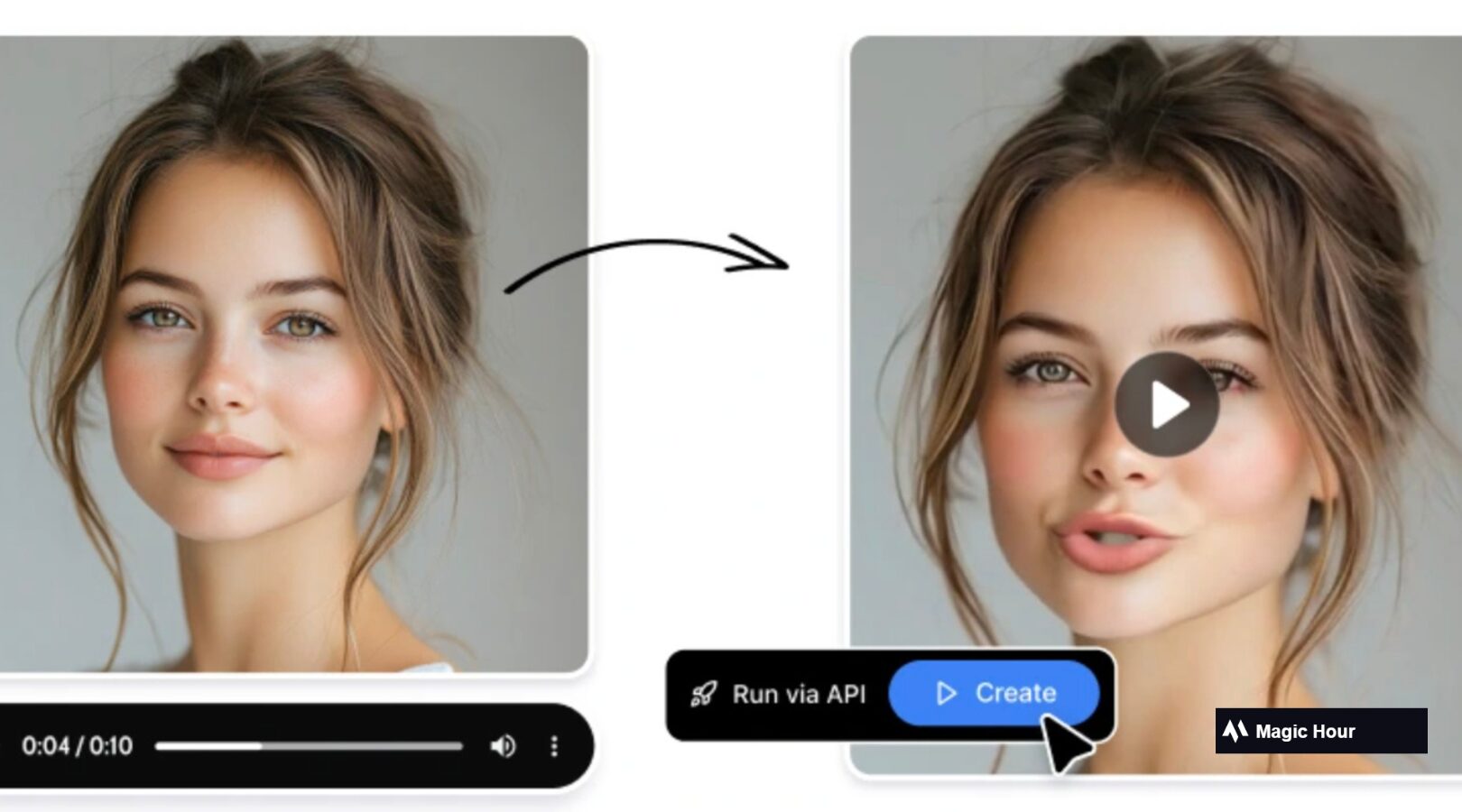
What impressed me wasn’t just the output quality — it was how practical the product feels for real creators. Magic Hour turns a photo into a speaking video without forcing you into rigid templates or overproduced avatars.
You upload an image, provide a script or voice input, and generate a natural-looking AI Talking photo with strong Lip Sync AI alignment. Facial movement tracks speech well, and expressions feel restrained instead of exaggerated.
There’s also a deeper story here. Magic Hour wasn’t built as a marketing stunt. It grew out of a genuine need to make video creation easier for small businesses. Early versions of the product reached hundreds of millions of views on social platforms, which tells you something important: the outputs work in the real world.
What Magic Hour Does Well
Pros
- Excellent lip sync accuracy on static photos
- Natural facial motion without cartoon effects
- Fast rendering compared to competitors
- Clean interface that doesn’t overwhelm new users
- Flexible enough for marketing, education, and social content
Cons
- Advanced workflows may require experimentation
- Limited customization compared to full 3D avatar systems
My Take
If you need AI Talking photo videos that don’t scream “AI,” Magic Hour is hard to beat. It’s especially strong for creators and startups who care about speed and realism more than novelty.
Pricing (Verified)
- Free Plan: Available with usage limits
- Creator Plan: $15/month (monthly) or $12/month (annual)
- Pro Plan: $49/month
For most users, the Creator plan hits the right balance of price and capability.
2. D-ID — Polished Talking Avatars for Business Use
D-ID has been in the AI avatar space longer than most. Its focus is clearly on business communication, training, and presentation-style videos.
The platform does a solid job turning a photo into a speaking avatar. Lip Sync AI accuracy is generally good, though facial motion can sometimes feel stiff compared to Magic Hour.
Pros
- Reliable results for corporate use
- API access for developers
- Supports multiple languages
Cons
- Less expressive than newer tools
- Interface feels enterprise-first, not creator-first
Evaluation
D-ID works well when consistency matters more than personality. For internal training or compliance content, it’s a safe choice.
Pricing
Offers limited free access with paid tiers scaling based on usage.
3. HeyGen — Speed-Focused AI Talking Videos for Teams
HeyGen is designed for teams that need to produce a lot of short videos quickly. Its AI Talking photo capabilities are decent, especially for sales and social media clips.
Lip sync is acceptable, though close-ups can reveal minor timing issues.
Pros
- Very fast video generation
- Good template library
- Team collaboration features
Cons
- Less realistic facial animation
- Output can feel templated
Evaluation
If speed matters more than subtle realism, HeyGen gets the job done.
Pricing
Free trial available, with paid plans for ongoing use.
4. Synthesia — Enterprise-Grade AI Video Creation
Synthesia is often the default choice for large organizations. It excels at producing consistent, brand-safe videos at scale.
While its Lip Sync AI is solid, Synthesia relies more on prebuilt avatars than pure photo-based animation.
Pros
- Enterprise-ready workflows
- Strong language support
- Trusted by large teams
Cons
- Less flexible for creative use
- Higher pricing barrier
Evaluation
Synthesia makes sense for structured environments, less so for individual creators experimenting with AI Talking photos.
Pricing
Demo-based access with enterprise pricing.
5. Rephrase.ai — Branded AI Spokesperson Videos
Rephrase.ai focuses on brand messaging and advertising. It allows companies to create consistent spokesperson-style videos using AI.
The photo animation works, but Lip Sync AI can feel slightly mechanical in longer clips.
Pros
- Strong for branded campaigns
- Custom spokesperson options
Cons
- Limited creative freedom
- No true free plan
Evaluation
Useful for campaigns where branding consistency matters more than expressiveness.
Pricing
Custom pricing only.
How I Evaluated These Tools
I tested each platform using the same criteria:
- Photo-to-video realism
- Lip sync timing and mouth accuracy
- Ease of use for non-technical creators
- Rendering speed
- Output suitability for marketing and education
I also evaluated whether the tools felt usable after the first project — not just impressive in a demo.
Where the Market Is Headed
The AI Talking photo space is moving quickly. The biggest trend I’m seeing is a shift away from flashy avatars toward subtle realism. Creators want tools that disappear into the workflow.
Lip Sync AI is also improving rapidly, especially for multilingual content. Expect more platforms to focus on voice authenticity and emotional tone rather than exaggerated facial movement.
Magic Hour’s trajectory fits this trend well, especially given its creator-first philosophy.
Final Takeaway
If you want the best balance of realism, speed, and control, Magic Hour is the top AI Talking photo and Lip Sync AI tool of 2025.
D-ID and Synthesia serve structured business needs well, while HeyGen and Rephrase.ai cater to speed and branding. The right choice depends on your use case — but Magic Hour is the most versatile option I tested.
I strongly recommend experimenting with at least two platforms before committing. The differences become obvious once you put them into real workflows.
FAQ
What is an AI Talking photo?
An AI Talking photo is a still image animated with speech, facial movement, and expression using AI, allowing the photo to appear as if it’s speaking naturally.
How accurate is Lip Sync AI in 2025?
Modern Lip Sync AI is accurate enough for marketing, education, and internal content, though close-ups can still reveal minor imperfections.
Is Magic Hour suitable for beginners?
Yes. Magic Hour is one of the easiest tools to start with, even if you’ve never created AI video before.
Can these tools replace video recording?
For many use cases — explainers, ads, training, and social content — they already have.